admin
By Mark Griffiths.
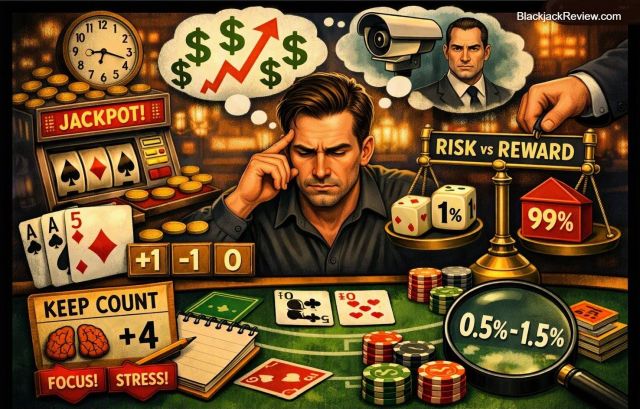
Most players sitting down at a blackjack table genuinely believe they are one system away from cracking the code. That belief — not the cards — is usually what gets them. Card counting in blackjack offers a real but brutally thin mathematical edge: somewhere between 0.5% and 1.5% over the house when executed with near-perfect accuracy. That’s it. And yet the psychology wrapped around this technique has made it one of the most obsessively pursued strategies in casino history.

Here’s the honest truth most guides skip: the technique itself isn’t what breaks people. It’s the gap between how difficult they imagine it to be and how much harder it actually is under real pressure. UK crypto casinos in 2026 run standard shoes of 4 to 8 decks specifically to dilute any running count advantage. The math gets murkier with every added deck. Still, players keep trying — and the reason why has almost nothing to do with the cards.
Why Your Brain Thinks This Is a Skill You Can Master
Pattern recognition is hardwired into human cognition. The brain doesn’t just notice patterns — it invents them when none exist. In a shuffled deck, this impulse goes into overdrive. A player sees three low cards in a row and immediately feels the count shifting in their favor. That sensation of “reading” the deck is real. The information it provides, though? Often noise dressed up as signal.
This is the clustering illusion doing its quiet, persistent work. The brain groups random events into sequences and assigns meaning retroactively. A run of face cards after a string of low ones feels like confirmation that the system works. Actually, it’s just variance. But variance dressed in the costume of a pattern is almost impossible to dismiss in the moment — especially when there’s money on the table and everyone around you is watching.
What compounds this is something called the illusion of control. Once a player has spent weeks learning a card counting system — Hi-Lo, KO, Omega II, whatever it is — the investment itself creates a sense of mastery. The feeling that you have a system, a method, a structured approach, makes the outcome feel more controllable than it objectively is. Probability doesn’t care about your preparation. The house edge doesn’t soften because you studied hard.
Confidence Gap Nobody Talks About
Roughly 70 to 80 percent of casual card counters cannot maintain counting accuracy under real casino conditions. That number sounds harsh until you sit down and actually try it. Maintaining an accurate running count across a 6-deck shoe while managing your bet sizing, keeping conversation going to avoid detection, watching the dealer’s pace and the discard tray — each of those is its own cognitive task. Stack them all simultaneously and the mental load becomes genuinely brutal.
Reliable Hi-Lo counting per shoe demands around 15 or more minutes of sustained, unbroken mental focus. Not “mostly focused.” Locked in. Any distraction — a cocktail waitress, a loud player next to you, a moment of self-congratulation after a big hand — and the count is already degraded. Most players wildly underestimate this going in. The cognitive load of executing multi-step counting under cover isn’t something you can simulate at your kitchen table with a practice deck. It’s a different animal entirely.
Players who have spent months building the skill tend to overestimate their real-table accuracy precisely because their practice accuracy was genuinely good. That gap — confidence outrunning competence — is where the real trouble lives. It’s not stupidity. It’s a predictable psychological trap that even intelligent, disciplined people fall into.
What Keeps Players Hooked on the System
Variable reward schedules are one of the most powerful behavioral reinforcement patterns known to psychology. And card counting, almost by structural accident, delivers exactly that. A session might go poorly for an hour, then suddenly three hands in a row hit perfectly against a favorable count. That cluster of wins — intermittent, unpredictable, intensely satisfying — is enough to reinforce the entire behavior loop regardless of the overall outcome.
These are the main psychological hooks that sustain counting behavior even when the results don’t justify continuing:
- Intermittent wins that feel like proof the system works — even if the session is net negative
- The sunk cost of weeks or months spent learning the technique, which makes quitting feel like waste
- Social identity built around being the “smart” player who plays with an edge rather than on luck
- The emotional pull of loss recovery — the idea that the count will eventually “turn” and recoup what’s gone
That last one — loss recovery impulse — is particularly insidious. After a bad run, the urge to “stay and count through it” is incredibly strong. The player has already identified as someone who plays with a system, with a rational edge. Leaving feels like abandoning the strategy mid-execution. So they stay. And the cognitive load keeps stacking.
At platforms, where digital blackjack variants shuffle after every single hand, the entire premise of card counting collapses mathematically — but many players still mentally apply counting logic anyway. That’s how deep the habit formation runs.
What Actually Happens in a Real Counting Session
Let’s be specific about what the 0.5% to 1.5% edge actually means in practice, because most players misread it. It does not mean winning more hands. It means — in theory, over a very large sample — that the expected return on each dollar wagered tilts very slightly in the counter’s direction compared to basic strategy alone. That edge is real but fragile, contingent on perfect execution, and almost entirely neutralized by a casino’s standard countermeasures.
Here’s a practical comparison of what players expect versus what the math and environment actually deliver:
What Players Assume | What’s Actually True |
Counting gives a substantial win advantage | The edge is 0.5–1.5% — thin and conditional |
A good count predicts the next hand reliably | It shifts probabilities marginally, not outcomes |
Casino staff won’t notice subtle bet spreading | Modern surveillance is specifically trained to spot spread patterns |
Practice accuracy transfers directly to the table | 70–80% of counters degrade significantly under live pressure |
More decks don’t meaningfully change the count | 4–8 deck shoes dilute the running count edge significantly |
And beyond the math, there’s the identity layer that the table above can’t capture. Being someone who counts cards — who “plays smart” — becomes part of how a player sees themselves. That self-image is powerful. It frames continued play as rational strategy rather than habitual behavior. It makes every losing session feel like a temporary variance problem rather than a fundamental reassessment trigger.
The common behavioral patterns across serious card counters tend to cluster around a few recognizable habits:
- Extending sessions well past the original time limit because “the count is favorable right now”
- Consistently overriding blackjack basic strategy decisions based on the running count — even when accuracy has already degraded
- Increasing bet size dramatically during perceived high-count phases, which is precisely what casino surveillance watches for
- Dismissing detection risk because self-assessed skill level creates false confidence in cover behavior
Real Edge Nobody Is Counting On
Mathematical mastery is a compelling story. More compelling, sometimes, than the math itself. The appeal of card counting isn’t purely about the edge — it’s about the narrative of the edge. Being the player who “figured it out,” who approaches the table with a system while everyone else plays on instinct. That narrative is reinforced by every session where the count behaved as expected, and rationalized away in every session where it didn’t.
The deck doesn’t know what you’ve memorized. Modern UK crypto casinos have engineered their table rules and shoe management specifically to make that 0.5 to 1.5% advantage as difficult to capture as theoretically possible. The counters who actually extract consistent value from the technique are extraordinarily rare — and spend enormous cognitive energy doing it. That’s the real math behind the myth. Knowing it doesn’t make the pull any weaker. But it does make the decision clearer.
IMAGE CREDIT: Microsoft AI Copilot
BLOG MENU
The post Blackjack Card Counting: Psychology & Reality appeared first on Blackjack Review.